Before Producing an AI Short Drama, What Should Your Test Footage Prove?
On this page
Test footage can help before you commit to an AI short drama series. But a collection of attractive faces, environments and music may leave the central questions unanswered: do these characters work within a scene, and can you sustain this approach across the story?
Before testing, write down what remains uncertain. Can viewers understand a setup? Does the relationship hold their interest? Can you produce a performance the story depends on? Different questions call for different footage.
Organize everything from scene selection to feedback around that question. The final record should tell you what to keep and what to change next.
01Distinguish test footage, a pilot episode and a trailer
These terms may be used differently by different teams. Here they’re differentiated by the questions they answer:
| Format | Question it answers | How to select the content |
|---|---|---|
| Test footage | Can a specific dramatic idea or production method work? | Choose a representative scene that exposes the uncertainty; it need not be episode one |
| Pilot episode | Does the opening introduce the characters and situation and make viewers want more? | Provide a complete episode-level viewing experience |
| Trailer | What will make people interested in the work? | Reorder highlights and withhold answers if useful; full cause and effect is not required |
Using a trailer to judge whether an entire episode makes sense can produce confusing feedback. The trailer may intentionally omit motives and outcomes. Conversely, footage testing a prop handover need not also prove that viewers will follow the whole series.
Decide which you need. If you want to test a key performance and the appeal of the opening, complete a focused test first, then use what works in a pilot episode. Record feedback from the two viewings separately.
02Give the test a question you can answer
"Checking the effect," "testing cinematic feel," and "verifying if it can be done" are all too broad. Even if you get a video, it's hard to know what to keep or modify next.
You can write your questions more specifically:
- Can the audience clearly explain why the protagonist changed his decision after watching this scene?
- When the two haven't explained everything from the past, can the images and dialogue reveal who is testing and who is avoiding it?
- Can a key action used repeatedly in the story be presented in an acceptable way?
- When this set of clips is connected, is the sequence of information and the characters' reactions clear enough?
Give each question a way to observe the answer. To check why a decision changes, ask someone unfamiliar with the script to explain it after watching. To check an action, list the beginning, movement and outcome that must be visible, then compare them with the footage.
Don't set "everyone likes it" as the default standard. Different people may understand the same scene but have different interests in the subject. Also, don't equate "no obvious flaws in the visuals" with the story being valid; A scene with accurate expression may still fail to advance the plot.
03Choose a scene the series will repeatedly depend on
Test footage should relate to later production. If the series depends on characters probing each other and making choices, leave room for dialogue, actions and reactions. Character introductions and empty establishing shots alone cannot show whether those scenes work.
Suppose you're planning to make a suspense short about partners hiding things from each other. You can choose this segment: the protagonist asks the partner to hand over the locker key, but the partner keeps refusing; After the protagonist reveals a new fact, the other party decides to hand over the keys but demands she agree to a condition.
This scene allows you to observe several things at once: whether their intentions are clear, whether new facts change the situation, whether handing over the keys is noticed, and whether the final condition brings new problems. It's closer to the repeated expression the drama needs to complete than a beautiful close-up of a single person holding the key.
Nor do you have to pick the most complex climax in the entire series in the first round. The climax may depend heavily on the background, making it hard for viewers to judge without watching it. You can choose segments with similar structure and less background burden to preserve the key difficulties.
If a climax truly determines whether the work stands, then verify it separately. Just don't overextend the success of an isolated difficult shot into a judgment about the entire show.
04Decide what needs to stay consistent
It is easy to change everything at once during a test: characters, visual style, dialogue and shot order. The new version may look better without telling you which changes helped.
For this round, fix the script passage, core character appearances, necessary actions and viewing order. When comparing one choice, keep other factors as consistent as possible and record differences you cannot control.
For example, if the first version didn't make people understand "why hand over the key," the second version could first make the new facts clearer and keep other plot points similar. If you change to another group of characters, replace the dialogue, and add explanatory narration, then you can only judge that the new expression is clearer, and you can't attribute all improvements to a single model or a particular prompt.
This doesn't require every creation to be a rigorous experiment. Recording changes is to avoid mistakenly taking a once-satisfying result as something you've already mastered when continuing to work later.
05Assemble a continuous test sequence in Panco
Prepare the selected scene as a script and bring it into the Panco script workflow. Review the episode text, characters and props. Check that the storyboards include the changes you need to observe before choosing a model and generating footage.
For the key handover, do more than check that a key appears. Who holds it? When is it offered? Does the other person receive it? Why does the character agree now? Record whether a movement error simply looks awkward or changes the viewer’s understanding of the event.
Generation history helps you revisit the prompts and linked references. You can also keep your own notes on why you selected or rejected a clip, what you adjusted and why you abandoned a version. Those notes support later comparisons better than keeping only the strongest final clip.
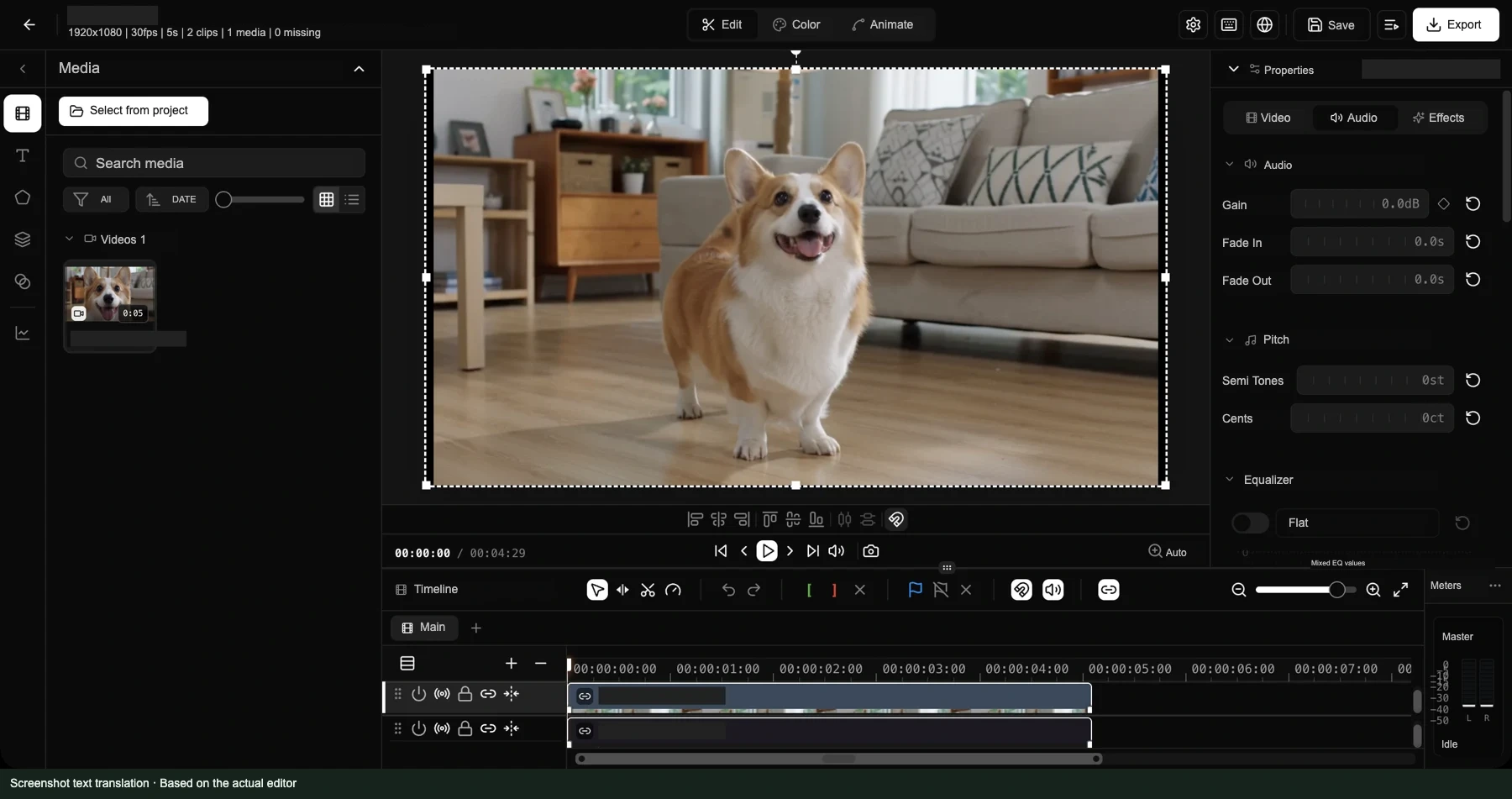
Once you have usable video, select the project’s clips in Panco’s editor, arrange them in story order, and make the necessary cuts and sound adjustments. See the project video editing tutorial for the steps.
Before giving it to others to watch, at least confirm that the order of information, necessary sounds, and segment transitions can be understood properly. If the missing dialogue perfectly explains the character's motivation, the viewing feedback alone cannot reflect the script's issues. Record the version and production completion level to avoid mixing and comparing samples in different states.
06Record understanding, interest and feasibility separately
Let someone unfamiliar with the script watch first, without explaining what you want them to notice. Afterward, use open questions to understand their experience.
For example, you can ask: "In this scene, what do both people want?" "Why do you think the other person handed over the key in the end?" "Which part needs to be rewound to look?" "If it continues, what do you most want to know?"
Avoid opening with “Was that line what helped you understand?” It puts the answer into the question. Let the viewer recount the scene freely, then ask about specific uncertainties.
Audience feedback can be organized separately from actual production records:
| Area | What to record | What it may reveal |
|---|---|---|
| Understanding | The goals, events and causal links the viewer recounts | Missing information, unclear order or an action that communicates the wrong thing |
| Interest | Who or what they want to follow, or where their attention drifted | Whether the premise and character choices engage this viewer |
| Production quality | The specific image, sound or transition that affected viewing | A shot, performance or post-production problem |
| Continued production | Actual generation, revision, selection and editing work | Resources and changes the approach may need in later scenes |
If the other person says "not very good," you can ask if they didn't understand it, aren't interested in the subject, or if a scene interrupted their viewing. Different reasons require different revisions. Don't combine all feedback into a score just to get a vague satisfactory review.
Feedback from a small number of viewers helps identify problems and form the next round of hypotheses, and cannot be used to claim the work has been market-validated. Noting whether they are familiar with this genre can also help understand disagreements.
07Finish with a specific next decision
After completing one round of production validation, conclusions can be summarized in the following scenarios:
| Observed situation | What can be done next? |
|---|---|
| Core causes and effects can be restated, and fragments can be completed according to established methods | Bring the already effective expressions and production records into the next scene, and continue to observe the scope of application |
| The characters are attractive, but the key changes are misunderstood | Modify the corresponding information or actions, then verify that segment without rushing to redo all the footage |
| The story is understandable, but the actual production repeatedly gets stuck in certain scenes | Adjust filming methods, resource allocation, or creative scope to confirm whether the core highlights are still retained |
| Key promises remain unfulfilled, and alternative methods alter the appeal of the works | Reassess the topic or postpone production, clarifying what conditions are still missing |
Make the conclusion actionable: “Keep the characters and setting, rewrite the reason for handing over the key, and test the continuous sequence again.” This guides the next round better than “It feels okay; keep improving.”
Give the test a stopping point. New issues will keep appearing, but the first test does not have to solve all of them. Complete the agreed checks, decide the next step, and carry unresolved questions into the stage best suited to answer them.
08Questions about AI short drama test footage
How long should the test footage be?
Focus on fully presenting the current round's questions. Checking an action may only require short clips, but checking character changes requires causes, reactions, and outcomes. To verify the pilot viewing experience, one episode should retain the necessary process and not replace it with just a few exciting shots.
Do I need video if the text or static storyboards already make sense?
Text and storyboards help check structure and information, and videos also include duration, performance, sound, and editing relationships. Whether to enter the video stage depends on current uncertainty. If the question is about performance or transition, corresponding dynamic clips are needed; If the script's cause and effect are not yet sorted out, the text can be revised first.
If there are minor issues in the visuals, will they affect your judgment?
See if the question touches on the content to be verified this round. Details in the background that do not affect understanding have different meanings than "the key was handed to the wrong person." Record the problem and then judge whether it disrupts viewing or has already changed the plot; there is no need to treat all flaws equally.
09Answer one question before expanding production
The value of AI short drama test footage lies in the decisions you can make afterward. Choose a question that matters to the work, observe it through a representative scene, then consider comprehension, interest and production records together.
Write down what to keep, what to change, and what still needs to be confirmed in this round. When you move on to the full production, what you take away isn't just a video, but a set of working methods you know are applicable.
10Expand a successful test into a three-episode pilot
Once the scene answers its test question, plan three distinct episode turns: establish the problem, make the first choice produce a consequence, then resolve one immediate question while opening the next. Three episodes are a manageable planning example, not a platform requirement. Reuse the approved characters and location before introducing another difficult production variable.
Write an acceptance condition for each episode and review it with someone who has not read the outline. Record story comprehension separately from production cost. Use the same reference versions and shot ledger so the pilot tests repeatability as well as audience interest.
Plan a ReelShort-style vertical pilotEstimate the pilot cost