Why Viewers Start the Next Episode: Structuring a Short Drama
On this page
It is easy to end an episode as a door opens, a phone rings or the protagonist looks shocked. The harder task is making sure the next episode moves the story forward and addresses what viewers were waiting to learn.
If every episode approaches an answer only to push it farther away, watching a series can feel like waiting in place. Decide what each episode delivers and what new problem follows from that result.
The fictional example below follows a performer trying to recover her place in an audition. Across four episodes, each inquiry reveals something that forces her next action.
01Start with the result of each episode
Give the story an ongoing goal, then give each episode a smaller goal that can change the situation.
For example, an understudy discovers she has been removed from the final audition. She wants the opportunity back and needs to find out who submitted a withdrawal request in her name.
That goal can sustain several episodes. Episode one need not reveal everything; securing a chance to check the records is already a result. Episode two traces the submission, episode three asks who handled the device, and episode four turns the new evidence into a decision.
The outcome of each episode can be either a success or a failure. She goes to the person in charge to request reinstatement, but is clearly refused, only to discover that the application uses a term only acquaintances know. The opportunity isn't taken back, but the investigation direction changes, and this episode still makes progress.
When writing the episode outline, besides "what happened," add another sentence: "By the end of this episode, what is already different from the beginning?" If this sentence can only be written as "the protagonist is more anxious," then you need to see if the plot truly changes her situation.
02Connect actions and consequences across four episodes
We can first arrange this story into the following structure. Four episodes is just the length of this example, not a fixed formula for short dramas.
| Episode | Immediate goal | Obstacle and action | Result | Question carried forward |
|---|---|---|---|---|
| Episode One | Striving to Restore Audition Eligibility | The person in charge insists that the withdrawal request is valid; she points out that the request time coincided with her stage rehearsal and asks to check the records | The person in charge agrees to keep the records and allows her to explain the situation before the final list is confirmed | Where exactly was the request submitted from? |
| Episode Two | Find the source of the impersonated submission | Records show the request came from a shared backstage tablet, not an unknown device; she cross-checks the rehearsal schedule for that night | She discovers that her partner had held the already-logged-in tablet for her during that time | What did the partner do with the tablet? |
| Episode Three | Verify with the partner | The partner admits to opening the account but claims they were helping upload audition files; the two check the saved files together | The files show someone else modified the uploaded content, and the partner is willing to hand over the handoff messages from that time | Were the file modification and withdrawal request done by the same person? |
| Episode Four | Use the handoff messages to continue the investigation | The messages point to the teacher guiding her rehearsals; she decides to ask in person and receives an explanation different from her understanding | The teacher admits to arranging for someone else to submit the withdrawal request without permission, claiming it was to help her take another job | How can she reclaim her decision-making power, and how should she handle the student-teacher relationship? |
The purpose of this table is to help the writer check cause and effect. Episode One secures the records, leading to the search in Episode Two; Episode Two locks in the handoff period, leading to the conversation in Episode Three; the new material from the partner drives Episode Four to the meeting with the teacher.
When actually writing, you still need to fill in whether the evidence is sufficient and why each person acted as they did. For example, why the teacher thought she had the right to decide for her, or who actually handled the withdrawal request—don’t gloss over this just because the outline has reached Episode Four. The episode table exposes these questions, making it easier for you to deal with them before generating scenes.
03End after something changes
The same scene can end in different places, giving the audience different feelings.
If Episode Two ends with “she opens the record, revealing a shocked expression,” the audience will wonder what’s on the screen. But if she first confirms the submission came from the shared tablet, then cuts to her partner walking over with the same tablet, the question shifts to: how will she ask, and how will the partner respond?
The first approach hides information, while the second gives the information to the audience and lets them anticipate the action. Both can be used; the choice depends on how the next episode plans to unfold.
Several changes can provide a natural episode ending:
- A judgment was overturned by new facts: it was thought that strangers had impersonated the user, but the source was a familiar device.
- A relationship changes: the person who was previously suspected decides to offer help.
- The protagonist makes a decision that will be hard to undo: she takes the evidence to someone she has always trusted.
- A small goal is achieved, but an even greater cost is revealed: there is hope for restoring qualifications, but the teacher's overstepping of authority must be made public.
Don't just look at whether the ending is sudden. Also check if the moment is based on what has already happened in this episode. If every ending relies on someone who never appeared before to bring news, the protagonist's own investigation easily loses its purpose.
04Carry the previous question into the next episode
If the previous episode clearly promised "the protagonist will immediately ask the partner," the next episode should push that question forward. New obstacles can arise first, but obstacles must change the plot, not just delay the same sentence.
For example, when a partner refuses to talk in public, the two move backstage, and the audience learns she's worried a third person might overhear. This adds meaning to the refusal. Conversely, repeated arrangements for a dead phone, interruptions, and the protagonist forgetting to ask questions only keep delaying the same answer.
When explaining the background, you can also have reminders appear with the current purpose. The protagonist takes out a record and says, "At this time yesterday, you kept my tablet for me," giving the audience clues and forcing the partners to respond. There's no need for the two to retell the full story from the previous episode.
Watch two episodes in a row to check whether the questions raised in the previous one were addressed in the next: answered, disproven, or replaced by more specific questions due to new facts. As long as the story continues in one direction, there's no need to change the larger secret every episode.
05Check for progress, not repeated arguments
An episode outline may seem to have many events, but in reality, it may only do one thing.
In episode one she requests reinstatement and is refused. In episode two she asks a different person and is refused. In episode three she asks through tears and is refused again. Without new conditions, different costs or a changed relationship, the running time grows while the situation stays the same.
When revising, you can write two short lines per episode: what she knows at the beginning and what she can do; what she knows and what else she can do after the end. Then look at what changes actually occur between the two lines.
This doesn't mean every episode has to be a major event. A conversation between two people can also change the whole story: the person who originally refused to help explains their concerns, the protagonist chooses to take the risk, and both sides begin to cooperate. The weight of the change comes from its impact on subsequent actions.
If removing an episode leaves the sequence intact, consider moving its useful information into a neighboring episode. If that makes the emotional change too abrupt, keep the necessary steps instead of shortening for its own sake.
06Compare episode beginnings and endings in Panco
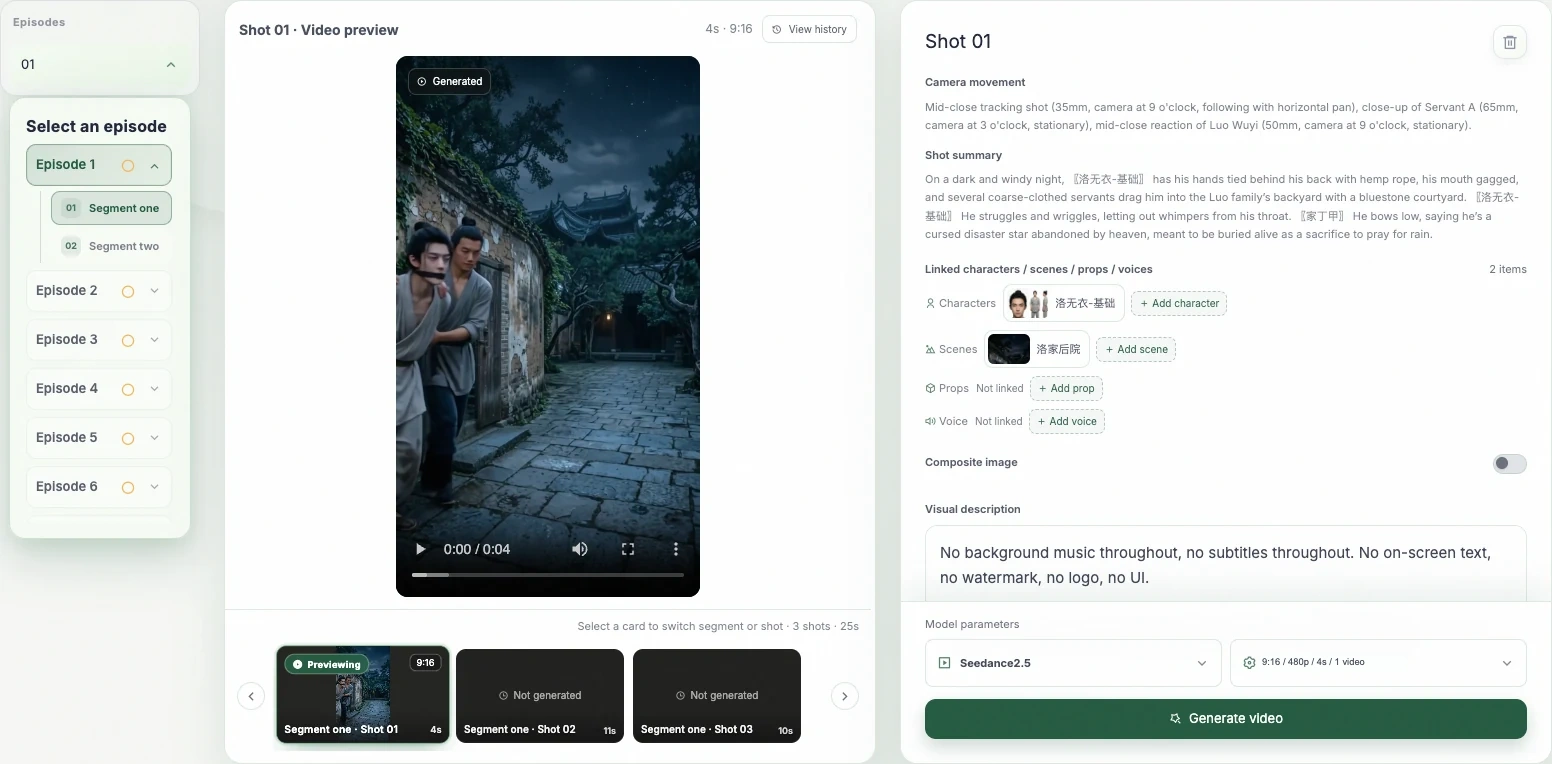
After developing the episode outline into a script, you can view the episode text in Panco Script Workflow, edit the current episode, and then continue with elements and storyboarding.
Read two neighboring episodes as one continuous sequence. By the end of episode two, she knows the submission came from the tablet; episode three should not begin as though she has no clue. If episode three establishes cooperation, episode four needs a reason to return the partners to suspicion.
Check that the evidence driving the plot reaches the visuals or dialogue: the records, the tablet handover and the partner’s agreement to help. The Agent’s storyboard breakdown gives you material to review; the causal links and character behavior still need your judgment.
Once you have available clips, arranging the endings and beginnings of two episodes in a row in the project editing allows you to more directly check for repeated explanations, sudden jumps, or missing responses. For specific steps, refer to Panco Project Video Editing Tutorial.
07Questions about short drama episode structure
Does every episode have to end with a twist?
No. A decision, a reunion, a repaired relationship or a clear failure can all make meaningful endings. Each episode should complete something and give the next events a reason to happen. If every ending overturns the earlier story, the characters’ efforts may start to feel meaningless.
Does every episode need a fixed length?
First, determine the general scope based on the planned release location and the form of the work, then check whether the episode's questions can be clearly developed within that scope. If it's too long, look for repeated information; if too short, judge if necessary responses are missing. There is no single set of seconds to guarantee viewing performance.
Can I change the episode breaks after writing the outline?
Yes. A read-through or rough cut may reveal a better stopping point. After moving a scene, check what each character knows, where the props are, and what the previous episode promised. If the partner’s explanation moves into the next episode, the earlier episode cannot already quote her answer.
08Make one episode’s result the next episode’s starting point
For short dramas, start by practicing with three or four short episodes. Write a list of goals, actions, and new situations for each episode, then read them repeatedly to see which episodes are just waiting and which truly push the characters forward.
A question becomes worth following because the earlier story gives it weight. Leave a question at the end, then handle it carefully in the next episode to keep delivering on the expectations you created.